First Public Voices Forum Held in Budva: Bringing European Integration Closer to Citizens
Regional cooperation, open dialogue and effective public communication are key to strengthening citizens’ trust and fostering a better understanding of European integration and reform processes, it was emphasised at the Public Voices Forum.
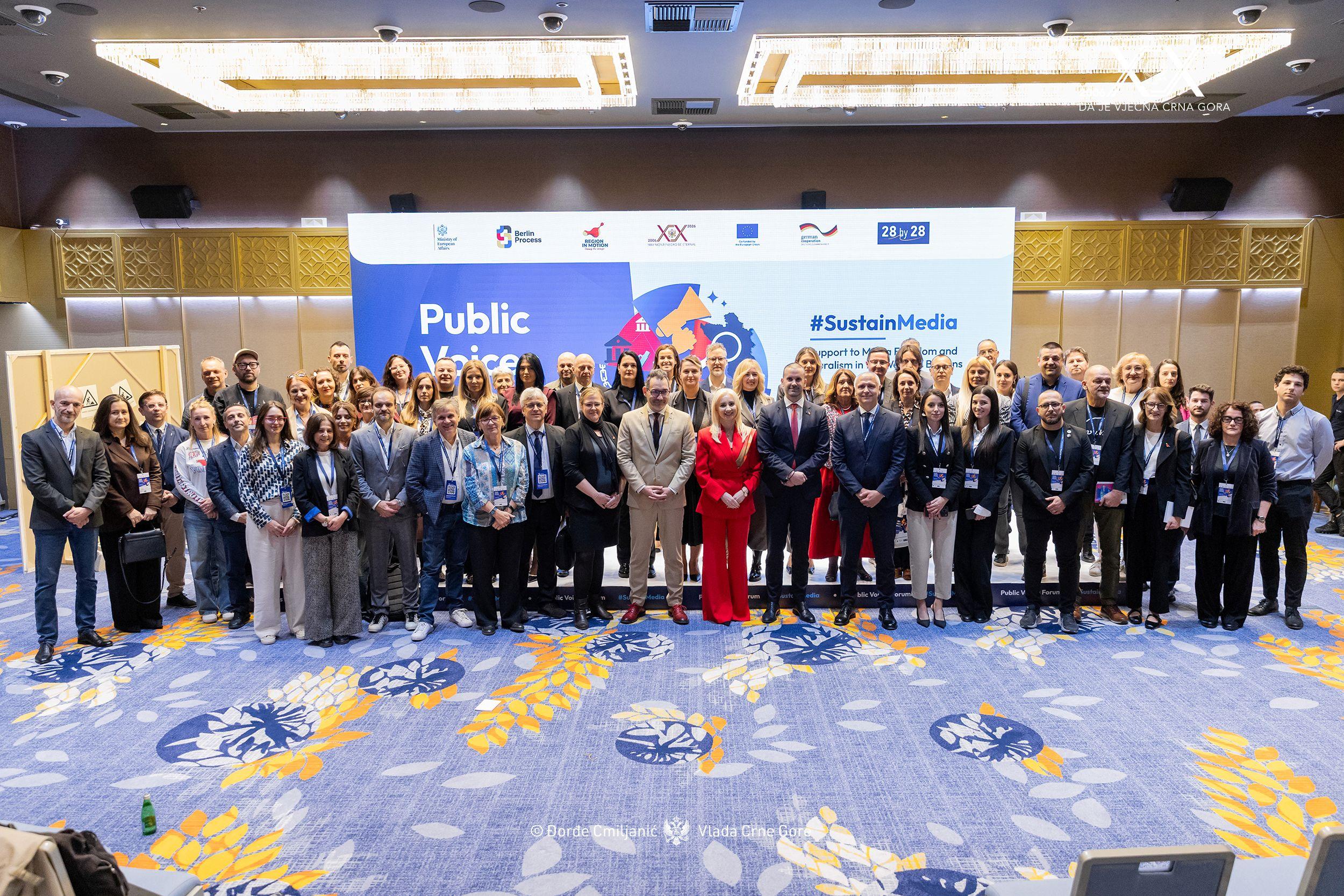
The two-day Forum held in Budva was organised by the Ministry of European Affairs of Montenegro in partnership with the European Union and the Federal Government of Germany, and with the support of the SustainMedia project.
The event, organised for the first time within Montenegro’s Chairmanship of the Berlin Process, brought together media professionals, public communication experts, representatives of regional organisations and political leaders, who exchanged views and ideas on how to communicate European integration, regional cooperation and the results of reform processes on the path towards EU membership in a clearer, more accessible and more effective way.
As part of the Forum, Prime Minister of Montenegro Milojko Spajić took part in a discussion entitled “From Citizens to Policy: Thinking Together - How to Communicate European Enlargement”, moderated by Valeska Esch, an expert on the Western Balkans and EU enlargement.
Prime Minister Spajić spoke about the importance of taking ownership of change, adapting communication to younger generations and establishing two-way communication that enables active dialogue with citizens and their involvement in decision-making processes.
He stressed that the success of reforms should not be measured solely by the adoption of legislation and the fulfilment of commitments, but also by the tangible changes that citizens experience in their everyday lives.
The panel entitled “From Policy to Citizens: Communicating European Integration and the Role of the Berlin Process” featured Montenegro’s Minister of European Affairs Maida Gorčević, Regional Cooperation Council Secretary General Amer Kapetanović, and GIZ representative Filip Radunović. The discussion was moderated by Vincenzo Le Voci, Secretary General of the Club of Venice.
The panellists highlighted regional cooperation as an important driver of the EU accession process, emphasising its potential to strengthen trust, consolidate democratic standards and advance European integration.
They also exchanged views on how initiatives under the Berlin Process could be communicated to citizens more effectively, using concrete and visible examples of the benefits that regional cooperation brings.
Opening the Forum, Minister of European Affairs Maida Gorčević said that the Berlin Process had further strengthened connections across the region, but that its achievements – just like those of European integration – must not remain understood only by those sitting at the negotiating table.
“As Montenegro approaches the final stage of its EU accession negotiations, we want our progress to inspire the entire Western Balkans,” the Minister said.
“What do these processes mean for young people seeking opportunities, for businesses looking for new markets, or for families hoping for a better quality of life? These are the stories we need to tell more clearly. We may have different responsibilities and may not always agree. But we share an interest in societies where facts matter, institutions are accountable, and citizens are able to make decisions based on reliable information,” Gorčević emphasised.
Milica Perišić, Adviser to the Prime Minister and National Coordinator for the Berlin Process, noted that the Presidency had been guided by the motto “Region in Motion. Owning the Change.” And focused on four priorities: economic growth, competitiveness, security and resilience, and the green transition.
“Over the past several months, we have organised 25 events as part of our Presidency, including ministerial meetings dedicated to foreign affairs, internal affairs, the economy, agriculture, labour, the Green Agenda, youth, Roma inclusion, public administration and the creative economy, as well as the Youth Forum, the Digital Summit, the Joint Science Conference and many other formats,” Perišić said.
Ambassador of the Federal Republic of Germany to Montenegro Edgar Alfred Gansen said that the Forum provided a platform for dialogue on how European integration, regional cooperation and reforms could be communicated more effectively to citizens across the Western Balkans.
“Fundamental objectives, such as strengthening the rule of law and democracy and combating corruption, bring direct benefits to society. Today’s event is a concrete example of efforts to promote the rule of law and democracy,” the Ambassador said.
He stressed the importance of presenting the European idea and European integration in a way that is clear, credible and relevant to citizens.
Photo and video materials are available through following links (source Montenegro Government): Link 1, Link 2, Link 3