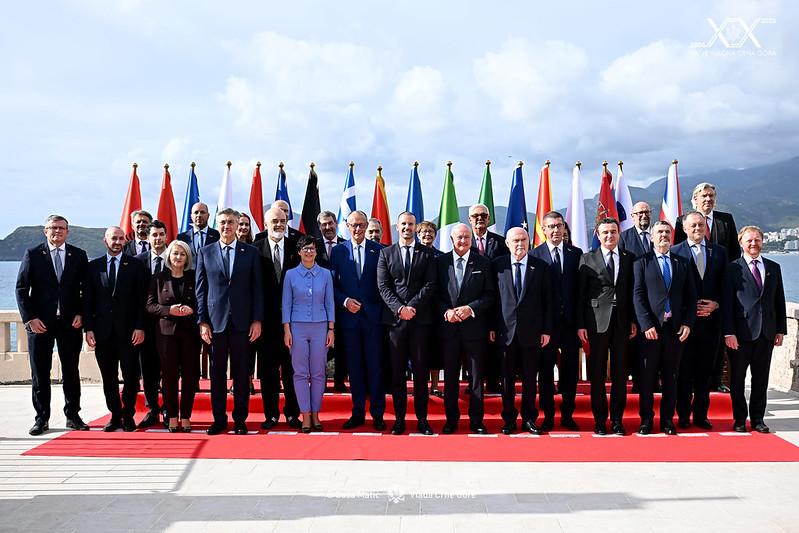
The Berlin Process Leaders’ Summit took place in Miločer, Budva on 22 October 2026, bringing together leaders of the Western Balkans and European partners to reaffirm their commitment to regional cooperation, economic integration and the European perspective of the region.
Hosted by Montenegro as part of its chairmanship of the Berlin Process, the Summit marked the culmination of a year of political dialogue and cooperation under the motto “Region in Motion. Owning the Change.”
The Summit was opened by the Prime Minister of Montenegro, Milojko Spajić, and the Federal Chancellor of Germany, Friedrich Merz, whose country launched the Berlin Process in 2014. The meeting also brought together the Federal Chancellor of Austria, Christian Stocker, European Commissioner for Enlargement Marta Kos, high-level representatives of the EU Member States and the United Kingdom participating in the Berlin Process, as well as regional and international organisations, and international financial institutions.
Discussions focused on advancing the European integration of the Western Balkans, strengthening regional economic cooperation and connectivity, enhancing competitiveness, and addressing shared security and resilience challenges. The leaders also considered the importance of reforms, stronger institutions and closer cooperation in delivering tangible benefits for citizens and businesses across the region.
In his opening address, Prime Minister Spajić underlined that Montenegro’s progress towards EU membership should also create opportunities for its neighbours. He highlighted the importance of the Common Regional Market, closer integration with the EU Single Market, investment in education and infrastructure, and a credible, merit-based enlargement process. He also reaffirmed Montenegro’s commitment to regional solidarity, European values and the continued development of the Berlin Process beyond its chairmanship.
Chancellor Merz reaffirmed Germany’s support for the European integration of the Western Balkans, stressing the importance of political commitment, reforms and the rule of law in advancing the accession process. He underlined that closer European integration is in the shared interest of the region and the European Union. Chancellor Stocker welcomed Austria’s forthcoming chairmanship in 2027 and identified youth, reconciliation and regional cooperation as key priorities for the next phase of the Process.
The Summit also provided an opportunity to take stock of the progress achieved through Montenegro’s 2026 chairmanship. Throughout the year, Montenegro hosted a broad programme of ministerial meetings and accompanying activities involving regional and European institutions, civil society, academia, the business community, the media and young people. The programme reflected the chairmanship’s four priorities: strong and inclusive economic growth, competitiveness, security and resilience, and a green and sustainable transition.
The meeting reaffirmed the importance of sustained political engagement, practical regional cooperation and a credible European perspective for the Western Balkans. It also marked the handover to Austria, which will chair the Berlin Process in 2027, building on the commitments and achievements of previous chairmanships.
As Montenegro concludes its chairmanship, it remains committed to advancing the Berlin Process as a platform for dialogue, partnership and concrete progress towards a more connected, resilient and prosperous Western Balkans within a united Europe.
Leaders’ Summit materials