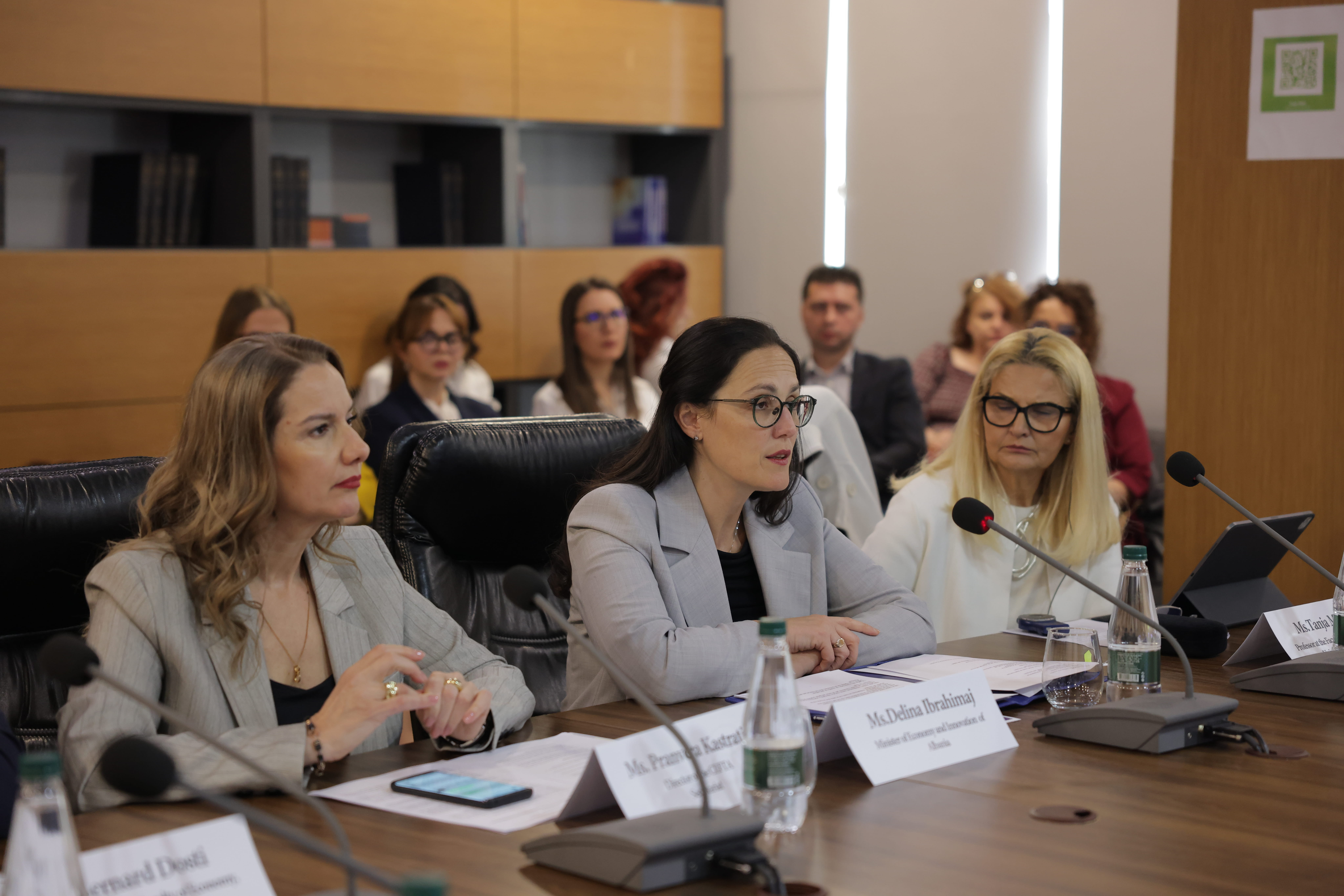
The CEFTA Secretariat launched the CEFTA Academic Network in Tirana on May 05, as part of the Albanian Chairmanship of CEFTA in 2026, bringing together policymakers, professors, researchers, students and partners to strengthen the link between academic research and CEFTA’s practical policy work.
Held as part of the Berlin Process 2026 programme, the launch contributes to the Montenegro Berlin Process Chairmanship’s focus on strong and inclusive economic growth and competitiveness by supporting research-based policymaking, stronger academic-policy links and practical solutions for economic cooperation in CEFTA.
The initiative builds on earlier CEFTA cooperation with academia, while responding to the new policy context shaped by the EU Growth Plan, the Common Regional Market Action Plan 2025 to 2028 and the wider Berlin Process agenda. As a renewed, open and voluntary channel for academic-policy cooperation, the Network places a strong focus on young researchers, especially PhD students and master’s thesis candidates, and on research that can produce actionable recommendations for CEFTA’s current work.
Opening remarks underlined the importance of connecting research with policy needs in an increasingly complex process of gradual integration with the EU Single Market.
Delina Ibrahimaj, Minister of Economy and Innovation of Albania, underlined the value of evidence-based policies for competitiveness, stronger support to businesses and closer alignment with EU standards.
Valentina Superti, Director for the Western Balkans at the European Commission’s DG ENEST, highlighted the role of fresh ideas and innovative approaches in the reform and integration processes supported through the Growth Plan and the Common Regional Market.
Milica Perišić, National Coordinator for the Berlin Process in Montenegro, underlined the relevance of the initiative for the Berlin Process and Montenegro’s Chairmanship, highlighting the importance of strengthening the bridge between academia and policymaking.
Pranvera Kastrati, Director of the CEFTA Secretariat, presented the Network as a practical link between academic expertise and CEFTA’s policy work, stressing the need for stronger analytical foundations and research that can support concrete implementation.
A central part of the launch was the round table discussion on defining the research agenda in support of trade policymaking, moderated by Tanja Miščević, professor at the University of Belgrade. The discussion included contributions from Odeta Barbullushi, professor at the College of Europe, Tirana Campus; Gordana Djurović, professor at the University of Montenegro; Vančo Uzunov, professor at Ss. Cyril and Methodius University in Skopje; Besnik Krasniqi, professor at the University of Pristina; and Hatidža Jahić, professor at the University of Sarajevo, as well as other academics and participants joining the discussion in person and online.
The discussion helped shape the thematic focus of the upcoming CEFTA Research Award and brought valuable academic perspectives on how research can support practical solutions in trade in agri-food products, trade in industrial products and trade in services, with digitalisation as a horizontal principle.
Through the CEFTA Research Award, PhD students and master’s thesis candidates will be invited to develop policy-oriented research on practical challenges linked to CEFTA’s work, with the aim of producing actionable recommendations that can inform CEFTA structures and discussions.
The open call for the CEFTA Research Award will be published on Monday, 11 May, on the CEFTA website.
Pictures and Videos can be found here.